
“Condensation risk analysis” covers two different questions. Is moisture likely to condense on an internal surface, leading to mould? And is it likely to condense inside the construction, where it can damage materials unseen? Each needs a different method, and choosing the wrong one can give false reassurance.
Surface condensation
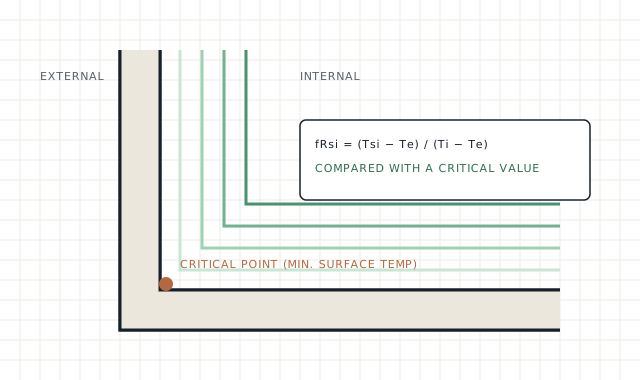
Surface condensation happens when warm, moist room air meets a cold surface – typically at thermal bridges such as wall–floor junctions, window reveals and corners. It is assessed by modelling the junction and calculating the temperature factor, fRsi, which is compared with a critical value from BRE IP 1/06 (commonly 0.75 for dwellings).
Read more: understanding fRsi and surface condensation risk.
Interstitial condensation
Interstitial condensation happens within a wall, roof or floor, where water vapour moving through the construction reaches a layer cold enough for it to condense. It matters particularly for internal wall insulation, warm and cold roofs, and timber-framed construction.
| Method | What it does | Limitations |
|---|---|---|
| BS EN ISO 13788 (Glaser method) | Steady-state calculation of vapour pressure and dew point through a build-up, month by month | Does not account for moisture storage, liquid transport, driving rain or built-in moisture |
| BS EN 15026 (dynamic hygrothermal modelling) | Simulates heat and moisture movement over time using real climate data | Needs detailed material data and specialist expertise |
| fRsi modelling (BS EN ISO 10211 / BRE IP 1/06) | Assesses surface temperature at junctions | Surface risk only – not within the construction |
BS 5250:2021, Management of moisture in buildings – Code of practice, is the overarching British Standard and explains when each type of assessment is appropriate.
Which analysis do you need?
- Internal insulation on solid walls: junction fRsi checks, and often dynamic modelling, because the Glaser method can be unreliable for solid masonry exposed to rain
- Cold or warm roof conversions: interstitial assessment of the roof build-up, plus junction checks
- Replacement windows: surface checks at reveals where insulation is limited
- Existing mould at corners: fRsi modelling to understand the junction, alongside a ventilation review
What no calculation covers
Calculations assume the construction is built as designed and that leaks, rain penetration and rising damp have been dealt with. They are tools to support good design – not a guarantee against moisture problems.
Need help with your property? We provide fRsi calculations and advise on wider condensation risk.
Sources and further reading
- BRE IP 1/06 – Assessing the effects of thermal bridging at junctions and around openings (overview, Designing Buildings)
- BS 5250:2021 Management of moisture in buildings. Code of practice (BSI)
- Historic England – internal wall insulation
- PAS 2035/2030:2023 transition – DESNZ letter (TrustMark, March 2025)
This guide is general information, not advice for a specific property. Standards and scheme rules change; check the current version before relying on them.