
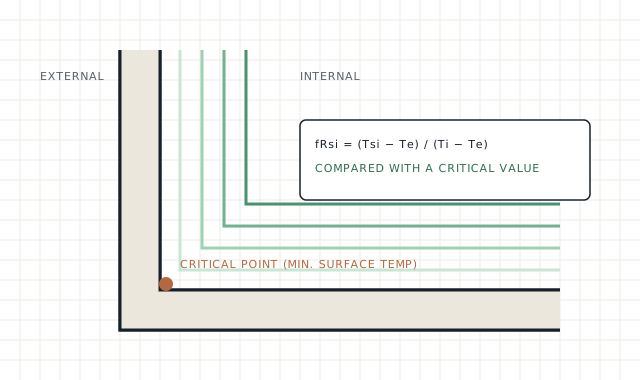
Mould often appears first at junctions – where a wall meets the ceiling or floor, around window reveals, or where insulation stops. These are thermal bridges: places where heat escapes faster and internal surfaces become colder. The temperature factor, fRsi, is a way of measuring how much colder.
What fRsi measures
fRsi compares the coldest internal surface temperature at a junction with the internal and external air temperatures:
fRsi = (Tsi − Te) / (Ti − Te)
Here Tsi is the minimum internal surface temperature, Te the external temperature and Ti the internal temperature. A value of 1 would mean the surface is as warm as the room air; a value of 0 would mean it is as cold as outside. Higher is better.
How it is calculated
Because junctions are two- or three-dimensional, fRsi is usually calculated with thermal modelling software following BS EN ISO 10211, using the actual layers, thicknesses and thermal conductivities of the materials.
Critical values
The result is compared with a critical temperature factor. BRE Information Paper IP 1/06, Assessing the effects of thermal bridging at junctions and around openings (T. I. Ward, 2006), provides critical values for different building uses. For dwellings, the value commonly applied is 0.75. You may see the paper referred to as “BRE IP106”; the correct reference is IP 1/06.
What fRsi does not tell you
- Interstitial condensation – moisture forming within the construction – needs a different assessment, such as BS EN ISO 13788 calculations or dynamic hygrothermal modelling to BS EN 15026.
- Rain penetration, rising damp and leaks are separate moisture sources that need investigating on their own.
- Behaviour over time – a solid wall’s moisture content changes through the seasons, which a steady-state fRsi calculation does not capture.
- Workmanship – a detail that passes on paper can still fail if it is built differently.
When to commission fRsi calculations
- Internal wall insulation meets floors, party walls or window reveals
- A detail is unusual or not covered by published guidance
- There is existing mould at junctions that you want to understand
- You need to compare alternative details
fRsi results are most useful as part of a wider moisture and ventilation assessment, not as a stand-alone sign-off.
Need help with your property? We can model junctions and report fRsi results for your details.
Sources and further reading
- BRE IP 1/06 – Assessing the effects of thermal bridging at junctions and around openings (overview, Designing Buildings)
- PAS 2035/2030:2023 transition – DESNZ letter (TrustMark, March 2025)
- Historic England – energy efficiency and historic buildings
This guide is general information, not advice for a specific property. Standards and scheme rules change; check the current version before relying on them.