
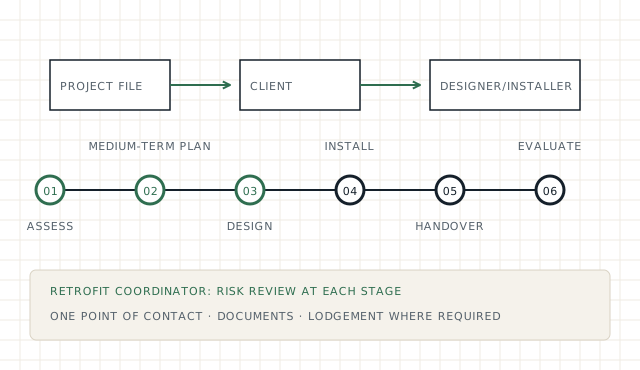
Retrofit projects involve several professional roles. On small projects one business may provide more than one of them; on funded projects, the roles are defined formally by PAS 2035:2023. Understanding who is responsible for what helps you commission the right services and avoid gaps.
The main roles at a glance
| Role | Main responsibility | Commonly cited qualification |
|---|---|---|
| Retrofit advisor | Initial advice to the householder about retrofit and the process | Varies by scheme |
| Retrofit assessor | Records the dwelling, its condition and occupancy; carries out the energy assessment | Level 4 Award in Domestic Retrofit Assessment, usually alongside Domestic Energy Assessor competence |
| Retrofit coordinator | Manages the retrofit process and technical risk from assessment to evaluation | Level 5 Diploma in Retrofit Coordination and Risk Management |
| Retrofit designer | Designs and specifies measures, including details and ventilation | Depends on project risk path and complexity |
| Installer | Installs measures to the design and relevant standards | Measure-specific; PAS 2030 certification or MCS where schemes require |
| Retrofit evaluator | Evaluates outcomes after installation where required | Depends on scheme and evaluation level |
Retrofit assessor
The assessor gathers impartial information about the home. Their job is to record accurately, not to recommend specific products. Their output feeds every later decision, so its quality matters.
Retrofit coordinator
The coordinator is responsible for the project as a whole. They review the assessment, evaluate improvement options, prepare a medium-term improvement plan, decide what level of design input the project needs, and check that risks are addressed as the work progresses. Where a scheme requires lodgement – for example through TrustMark – it is carried out by the retrofit coordinator.
The coordinator is not automatically a project manager or contract administrator. Programming trades, managing the site and administering the building contract are separate roles unless they are expressly agreed.
Retrofit designer
The designer turns the plan into specifications and details – what will be installed and how it connects to the rest of the building. The level of design depends on the project’s risk: simple measures on a straightforward house need less than internal wall insulation on a listed building.
Installer
Installers carry out the work and are responsible for workmanship. On funded schemes they typically need to be certified to PAS 2030 or MCS for the relevant measure and registered with TrustMark.
Why keep the roles distinct?
- Impartiality. Advice on what to install is more trustworthy when it is independent of who sells or installs it.
- Accountability. Clear responsibilities make it obvious who resolves each issue.
- Risk. A coordinator looking across all measures can spot interactions an individual installer might miss.
Individual qualifications versus company accreditation
A qualification belongs to the person who holds it. A scheme registration, such as TrustMark, belongs to the business. When comparing providers, ask who will carry out each role, what their qualification is, and which business holds any registration being relied on.
Need help with your property? We can explain which roles your project needs and who will carry out each one.
Sources and further reading
- PAS 2035/2030:2023 transition – DESNZ letter (TrustMark, March 2025)
- PAS 2035 competencies (Elmhurst Energy)
- TrustMark – find a registered business
- Warm Homes: Local Grant policy guidance (GOV.UK, July 2026)
This guide is general information, not advice for a specific property. Standards and scheme rules change; check the current version before relying on them.