
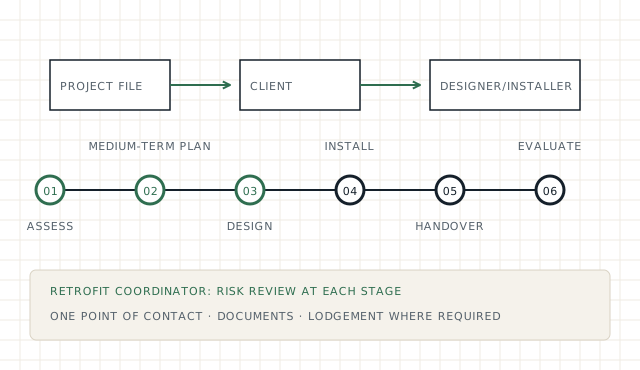
PAS 2035 is the British Standards Institution specification for domestic retrofit in the UK. It sets out how retrofit projects should be assessed, designed, installed, handed over and evaluated, so that energy improvements are planned as a whole and risks are managed. It is used alongside PAS 2030, which covers installation.
Which version applies?
The current editions are PAS 2035:2023 and PAS 2030:2023, published in September 2023. The previous edition (PAS 2035:2019+A1:2022) was withdrawn when the transition period ended on 30 March 2025.
When PAS 2035 is required
PAS 2035 is required for work funded through schemes including ECO4, Warm Homes: Local Grant and Warm Homes: Social Housing Fund, and where installers lodge work with TrustMark under the PAS framework. For privately funded projects it is not a legal requirement, but its structured approach is good practice.
The roles
- Retrofit advisor – initial advice
- Retrofit assessor – assesses the dwelling
- Retrofit coordinator – manages the project and its risks
- Retrofit designer – designs and specifies the measures
- Installer – installs to PAS 2030 or MCS as applicable
- Retrofit evaluator – evaluates outcomes where required
The stages
- Assessment of the dwelling, its condition and occupancy
- Improvement option evaluation and a medium-term improvement plan
- Design appropriate to the project’s risk path
- Installation by competent installers
- Handover with information for the occupants
- Monitoring and evaluation as required
What changed in 2023
- A medium-term improvement plan became mandatory
- An airtightness strategy is expected where fabric measures are installed
- A stronger emphasis on site inspection by the retrofit coordinator
- Clearer separation of design responsibility
PAS 2035 assigns each project a risk path, which affects the level of design required and the competence of the designer. Projects on traditional or protected buildings, or with higher-risk measures, need more design input.
What it means for you
- If your project is funded, ask the installer or scheme who your retrofit assessor and coordinator will be.
- If it is privately funded, decide whether to follow PAS 2035 in full or use its principles.
- Keep copies of your assessment, improvement plan, design and handover documents – they are useful for future work and when selling.
Need help with your property? We provide PAS 2035 assessment and coordination across London.
Sources and further reading
- PAS 2035/2030:2023 transition – DESNZ letter (TrustMark, March 2025)
- Warm Homes: Local Grant policy guidance (GOV.UK, July 2026)
- PAS 2035 competencies (Elmhurst Energy)
- TrustMark – find a registered business
This guide is general information, not advice for a specific property. Standards and scheme rules change; check the current version before relying on them.