
Insulation and draught-proofing should make homes warmer and healthier. Occasionally, damp or mould appears afterwards. Usually this is because ventilation was reduced, a cold junction was created, or an existing damp problem was covered over rather than fixed. Understanding the cause is the first step.
Types of damp
UK Health Security Agency guidance identifies four main types:
- Condensation – the most common form, when moist indoor air meets a cold surface.
- Penetrating damp – water coming through defects in the building’s exterior, such as roofs, gutters or pointing.
- Rising damp – moisture rising from the ground, often misdiagnosed.
- Traumatic damp – from leaks, such as burst pipes.
The same guidance notes that some energy efficiency interventions may reduce overall ventilation rates.
How insulation can contribute
- Reduced ventilation. Sealing draughts or fitting new windows removes air leakage that was carrying moisture away.
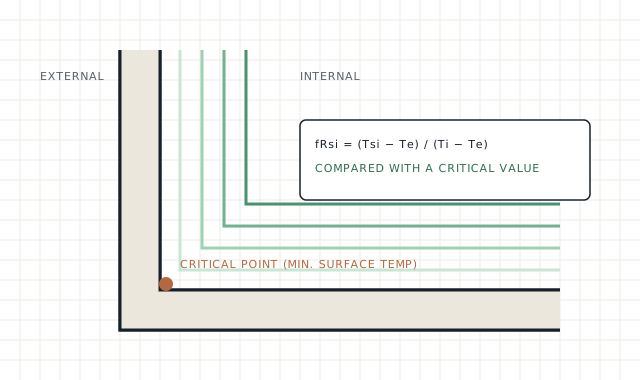
- Cold junctions. Where insulation stops – at a floor, window reveal or party wall – the remaining surface can become colder than before.
- Trapped moisture. Insulating a wall that is already wet, or using materials unsuited to a solid wall, can stop it drying out.
Ventilation rules
Approved Document F (Volume 1, 2021 edition) says building work should not reduce ventilation provision, and gives a method for assessing ventilation when carrying out energy efficiency work, with a checklist in Appendix D. When replacing windows in habitable rooms and kitchens where the old windows had no trickle vents, background ventilators of at least 8,000 mm² are expected (4,000 mm² in bathrooms). A 2026 edition takes effect on 24 March 2027.
Prevention
- Fix leaks, gutters and other defects before insulating.
- Assess existing ventilation and plan improvements alongside airtightness work.
- Design junctions carefully and check condensation risk where insulation stops.
- Choose materials suited to the wall, particularly solid masonry.
- Test airtightness and check ventilation after the work.
BS 5250:2021, Management of moisture in buildings – Code of practice, is the main British Standard for managing moisture in buildings.
Awaab’s Law
In the social rented sector, Awaab’s Law came into force on 27 October 2025. Landlords must investigate and make safe emergency hazards within 24 hours, and begin investigating significant damp and mould hazards within 10 working days, giving tenants a written summary within 3 working days of the investigation ending. A second phase covering further hazards begins on 30 November 2026.
For private rented homes, the government consulted from 9 October 2026 on extending Awaab’s Law under the Renters’ Rights Act 2025. At the time of writing it is not yet in force for private landlords.
Need help with your property? We can assess the causes of condensation risk and plan safe improvements.
Sources and further reading
- Understanding and addressing the health risks of damp and mould in the home (GOV.UK/UKHSA)
- Awaab’s Law in the social rented sector (GOV.UK)
- Consultation: extending Awaab’s Law to private rented tenancies (GOV.UK)
- Approved Document F Volume 1: dwellings, 2021 edition (GOV.UK PDF)
- BS 5250:2021 Management of moisture in buildings. Code of practice (BSI)
This guide is general information, not advice for a specific property. Standards and scheme rules change; check the current version before relying on them.